3 - Optimization
本页目录
Local Search
Hill Climbing
Choose a random state, and keep moving to a better neighbor state.
It can find the local extrema.
Variants:
- Steepest-ascent - always choose the highest-valued neighbor
- Stochastic - choose randomly from higher-valued neighbors
- First-choice - choose the first higher-valued neighbor
- Random-restart - conduct hill climbing multiple times
- Local beam search - maintain k states, expand all their neighbors, and retain the k highest-valued successors
Simulated Annealing
High temperature to lower temperature.
Less and less likely to accept worse result.
Function Simulated-Annealing (problem, max):
- current = initial state of problem
- For t = 1 to max:
- T = Temperature (t)
- If T = 0: Return current
- neighbor = random neighbor of current
- ΔE = how much better neighbor is than current
- If ΔE > 0:
- current = neighbor
- Otherwise, with probability e^(ΔE/T) set current = neighbor
- Return current
Local search can be used to solve TSP problem.
Linear Programing
- Minimize
c_{1}x_{1}+\dots+c_{n}x_{n}. - With constraints of form
a_{1}x_{1}+\dots+a_{n}x_{n}\leq bora_{1}x_{1}+\dots+a_{n}x_{n}=b. - With bounds for each variable
l_{i}\leq x_{i}\leq u_{i}.
Algorithms:
- Simplex
- Interior Points
import scipy.optimize

# Objective Function: 50x_1 + 80x_2
# Constraint 1: 5x_1 + 2x_2 <= 20
# Constraint 2: -10x_1 + -12x_2 <= -90

result = scipy.optimize.linprog(
    [50, 80],  # Cost function: 50x_1 + 80x_2
    A_ub=[[5, 2], [-10, -12]],  # Coefficients for inequalities
    b_ub=[20, -90],  # Constraints for inequalities: 20 and -90
)

if result.success:
    print(f"X1: {round(result.x[0], 2)} hours")
    print(f"X2: {round(result.x[1], 2)} hours")
else:
    print("No solution")
Constraint Satisfaction
- Set of variables
\{ X_{1},X_{2},\dots,X_{n} \} - Set of domains for each variable
\{D_{1},D_{2},\dots,D_{n}\} - Set of constraint
C
Graph of constraints : use a graph to express the constraints
- Hard constraints - must be satisfied
- Soft constraints - preferred to be satisfied
- Unary constraint - 1 variable
- Binary constraint - 2 variable
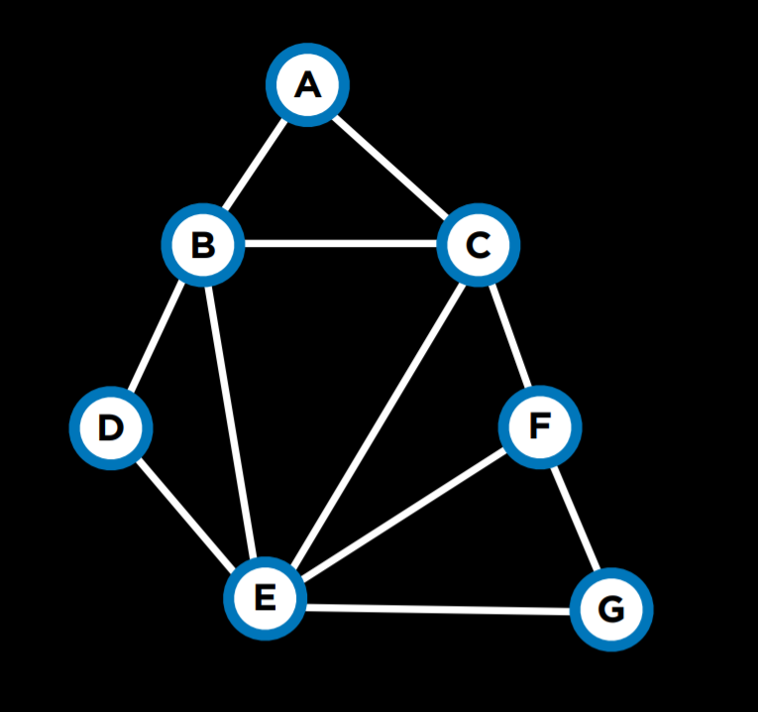
An edge connecting A and B - binary constriant (A,B)
Node consistency - unary constraint for A - remove some values from A ‘s domain
Arc consistency - binary constraint - edge
Function Revise (csp, X, Y):
- revised = false
- for x in X.domain:
- if no y in Y.domain satisfies constraint for (X, Y):
- delete x from X.domain
- revised = true
- if no y in Y.domain satisfies constraint for (X, Y):
- Return revised
Function AC-3 (csp):
- queue = all arcs in csp
- While queue non-empty:
- (X, Y) = Dequeue (queue)
- If Revise (csp, X, Y):
- If size of X. Domain == 0:
- Return false
- For each Z in X. Neighbors - {Y}:
- Enqueue (queue, (Z, X))
- If size of X. Domain == 0:
- Return true
Backtracking Search
CSPs as Search Problems
(Assigning each variable with a value and checking the constraints)
Function Backtrack (assignment, csp):
- If assignment complete:
- Return assignment
- var = Select-Unassigned-Var (assignment, csp)
- For value in Domain-Values (var, assignment, csp):
- If value consistent with assignment:
- Add {var = value} to assignment
- result = Backtrack (assignment, csp)
- If result ≠ failure:
- Return result
- remove {var = value} from assignment
- If value consistent with assignment:
- Return failure
Enhanced version: Maintaining Arc-Consistency
- Enforcing arc-consistency every time we make a new assignment
- Call AC-3
Select-Unassigned-Var
- Minimum remaining values heuristic - select the unassigned variable with the fewest remaining legal values
- Degree heuristic - select the highest degree
Domain-Values
- Least-constraining Values Heuristic: return values in order by #(choices ruled out for neighboring variables)