2 - Uncertainty
本页目录
Concepts:
- Conditional Probability:
P(a\mid b) =\frac{P(a\land b)}{P(b)}=\alpha P(a\land b) - Random Variables
- Independence:
P(a\land b)=P(a)P(b) - Bayes’ Rule:
P(b\mid a)=\frac{P(b)P(a\mid b)}{P(a)} - Joint Probability
- Probability Rules:
- Negation:
P(\neg a)=1-P(a) - Inclusion-Exclusion:
P(a\lor b)=P(a)+P(b)-P(a\land b) - Marginalization:
P(a)=P(a,b)+P(a,\neg b)P(X=x_{i})=\sum_{j} P(X=x_{i}, Y=y_{j})
- Conditioning:
P(a) =P(b)P(a\mid b) + P(\neg b)P(a\mid \neg b)P(X=x_{i})=\sum_{j}P(Y=y_{j})P(X=x_{i}\mid Y=y_{j})
- Negation:
Bayesian Network
A Bayesian network is a data structure (directed acyclic graphs, DAGs) that represents the dependencies among random variables.
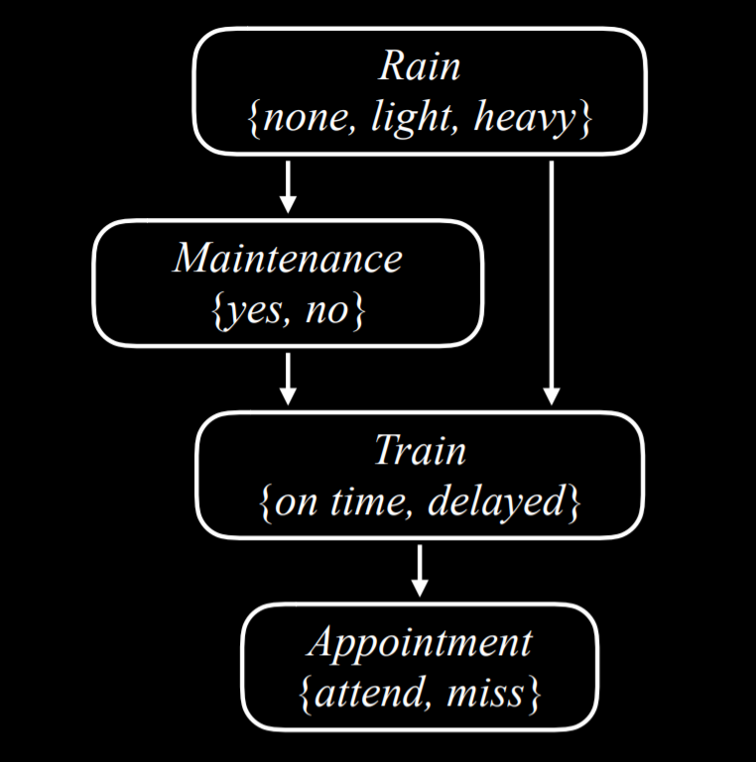
Concepts:
- Inference
- Query, Evidence variables, Hidden variables, The goal
- Inference by Enumeration:
P(X\mid e)=\alpha P(X,e)=\alpha \sum_{y}P(X,e,y) - Approximate Inference (Sampling):
- Each variable is sampled for a value according to its probability distribution.
- Likelihood Weighting:
- Fixing the evidence variables.
- Sample the non-evidence variables.
- Weight each sample by its likelihood: the probability of all the evidence occurring.
Markov Models
Concepts:
- Markov Assumption: the current state depends on only a finite fixed number of previous states.
- Markov Chain: a sequence of random variables where the distribution of each variable follows the Markov assumption.
- Observation and Hidden State
- Hidden Markov Models: Hidden states generate observed event (Sensor model).
- Sensor Markov Assumption: The evidence variable depends only on the corresponding state.
- Tasks:
| Tasks | Definition |
|---|---|
| Filtering | Given observations from start until now, calculate the probability distribution for the current state. |
| Prediction | Given observations from start until now, calculate the probability distribution for a future state. |
| Smoothing | Given observations from start until now, calculate the probability distribution for a past state. |
| Most likely explanation | Given observations from start until now, calculate most likely sequence of events. |