SUSTech CS109 - Java
本页目录
Java 简介(Introduction to Java)
Java 的语法基于 C++。
Java 之父:James Gosling。
Java 从源代码到运行:
- 编译器:编译源代码到字节码。
javac Main.java - 解释器(JVM):读取,识别,解释,运行字节码。
java Main
JVM:Java Virtual Machine,运行程序的虚拟机。
JRE:Java Runtime Environment = JVM + 核心类库。
JDK:Java Development Kit = JRE + 开发工具
变量名,方法名都是标识符(Identifiers)。标识符允许出现字母(含 Unicode)、数字、$ 和 _,不能以数字开头或使用保留关键字。
多行注释在遇到第一个 */ 时结束,不能嵌套。
/*
/* ..... */
*/ (语法错误)
转义字符(Escape Character):\n 换行,\t Tab,\" 转义 " 字符。
数据类型与计算 (Data Type and Calculation)
- 基础数据类型(Primitive Data Type),共有八种:
byte(8 bits), short(16 bits), int(32 bits), long(64 bits) // Integral Type float(32 bits), double(64 bits) // Floating-Point Type // 注意 float f = 1.2f 要在数字后加个 "f" 显式告诉编译器 boolean(true/false) char(16 bits, unicode) - 引用类型(Reference Type),也叫复杂数据类型(Complex Data Type)。
考虑 ++a or a++ 的区别。
逻辑运算符:与,或,非,异或。
&& or || 和 & or | 的区别:前者会短路,后者不会短路。
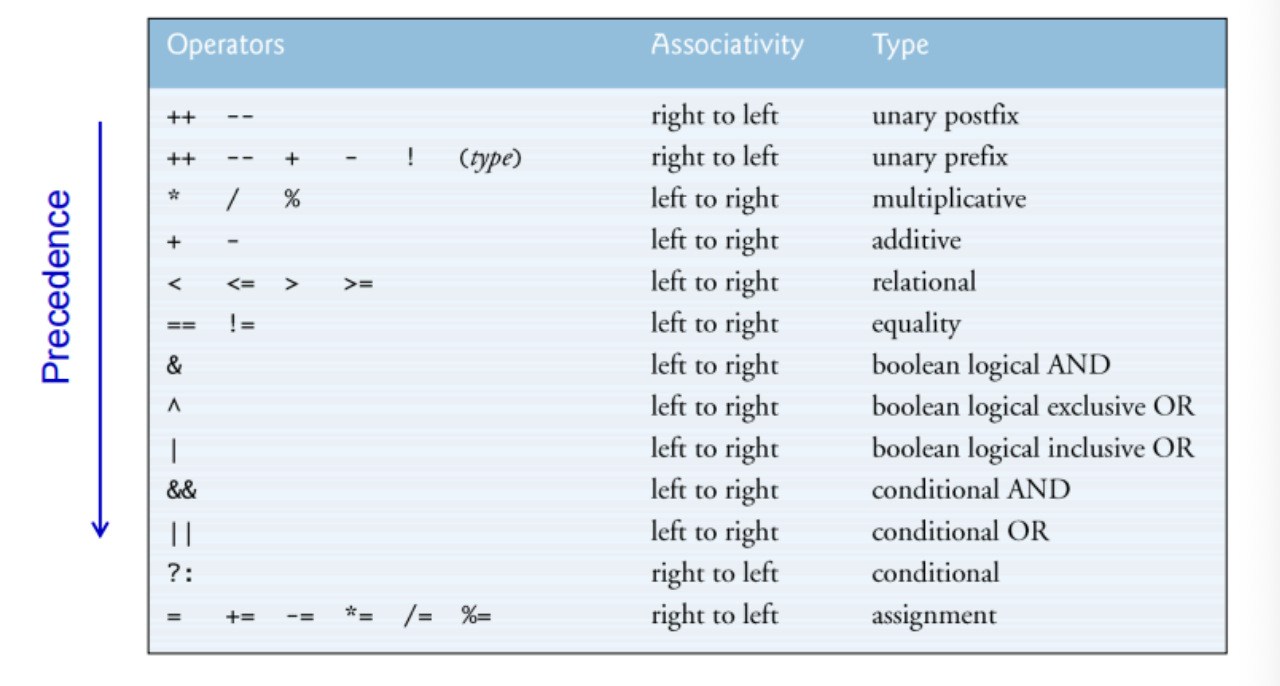
运算符优先级: 四则 > 比较 > 赋值。细则看这个图:
String.format("%d", 1) 返回格式化后的字符串 "1"。
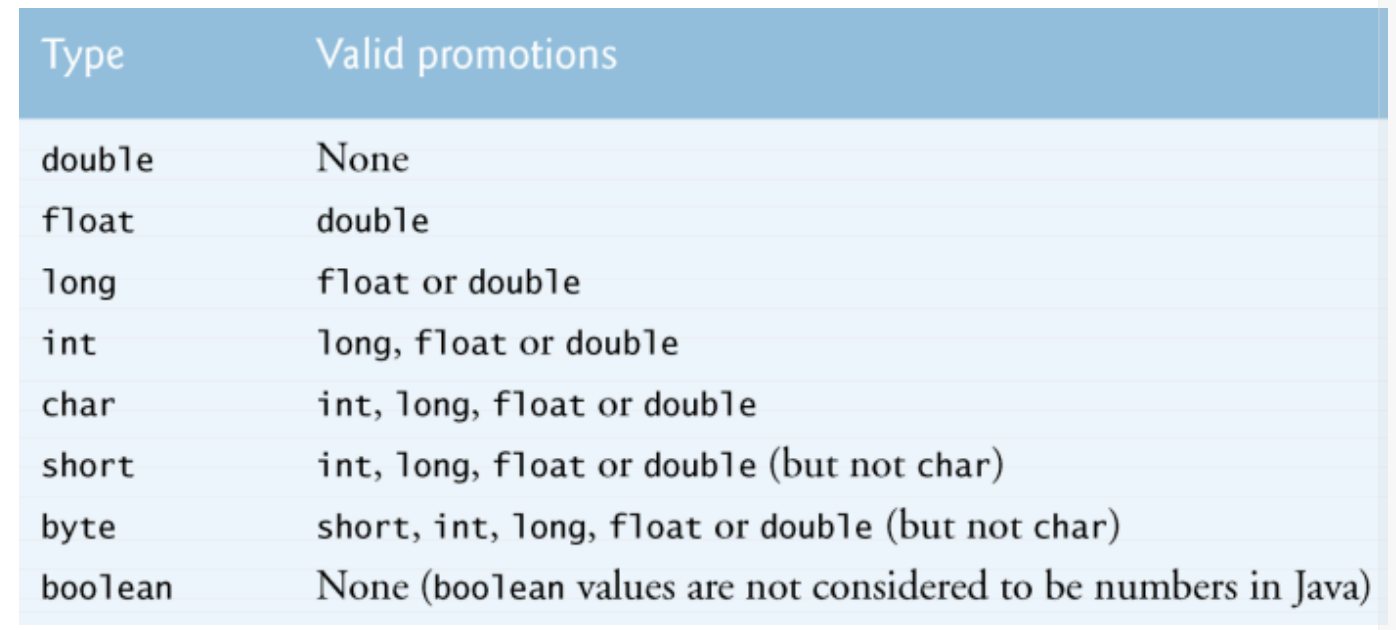
类型强制转换(Explicit Conversion) (double)a * b,其中 b 也会被隐式提升(Implicitly Promoted) 为 double。
拓宽转换不一定保留精度(例如 int/long 转 float 或 long 转 double);比如 float 可以提升为 double,short 可以提升为 long,反过来却不安全。
八大基础类型有对应的 Wrapper Classes
ArrayList<Integer> list = new ArrayList<Integer>();
Map<Integer, String>
控制语句(Control Statement)
注意 if 如果不加花括号的话只看它的下一句
if (a) {
	if (b)
		c;
}
// 没有花括号的话就是这两个匹配 if(b) c; else d;
else
	d;
注意 switch 要有 break,不然会穿透继续执行下面的代码。
switch 中的变量类型不能是浮点数 float / double。
switch (a) {
	case A:
		A1;
		A2;
		break;
	case B:
		B1;
		B2;
		break;
	default:
		D;
}
循环:for, while, do...while。
数组(Array)
数组 int[] a = new int[10]; 其中 10 为数组的大小。
创建后大小不能更改,大小通过 a.length 可以获取。
注意:
数组用a.length。
String / StringBuilder用a.length()。
List / Set / Map这种东西都用a.size()。
数组越界会抛 ArrayIndexOutOfBoundsException 异常。
初始化数组的方法:
int[] arr1 = new int[]{1, 2, 3}; // 正确
int[] arr2 = {1, 2, 3}; // 正确
int[] arr3;
arr3 = {1, 2, 3} // 不正确,必须使用 new 关键字
赋值操作只会更改数组的引用。例如:
int[] list1 = {1, 2, 3};
int[] list2 = {4, 5, 6};

list2 = list1; // list2 -> {1, 2, 3}
list1[0] = 0; // list2 -> {0, 2, 3}
多维数组:可以视为数组的嵌套。例如:
int[][] arr = new int[3][4];
int[][] arr1 = {{1, 2}, {3, 4, 5}};
方法(Method)
函数中的传参数:Java 一律按值传参:基础类型复制值,引用类型复制引用值。参数也会隐式提升。
同一个方法不同的签名(Signature,包括方法名与参数类型等,不含返回类型),可实现方法重载(Method Overloading)
可变数量参数 public static double sum(double... numbers)
调用栈(Method-Call Stack):调用方法时会创建栈帧,推入调用栈,然后在栈顶执行,执行完会弹出栈顶。
字符串与包装类(String and Wrapper Classes)
不可变字符串 String 是 Java 预定义的类(Predefined Class),也是引用类型。
String s1 = new String("hello");
String _s1 = new String("hello");
String s2 = new String();
String s3 = new String(s1);
char[] charArray = {'h', 'e', 'l', 'l', 'o'};
String s4 = new String(charArray);
String s5 = new String(charArray, 3, 2); // "lo"
String s6 = "hello";
String _s6 = "hello";
/*
注意,s6 是用字面常量(String Literals)创建的字符串,相同的字面常量会指向同一个地址。
s1 使用 new 关键字创建一个新的实例。
那么,会导致 s1 == _s1 为 false,而 s6 == _s6 为 true。
要比较字符串的值是否相同,要用 s1.equals(_s1) -> true
忽略大小写用 s1.equalsIgnoreCase("Hello") -> true
*/
s6 = "world";
// 注意字符串具有不可变性(Immutability),这个操作会让 s6 指向 "world" 这个常量的地址,但没有删掉 "hello" 这个常量的地址。
int len = s6.length(); // 5
char c = s6.charAt(0); // w
char[] charCopy = new char[3];
s6.getChars(0, 2, charCopy, 1); // charCopy -> {\u0000, w, o};

System.out.println("hello".compareTo("HELLO")); // 32 ('h' - 'H')
System.out.println("he".compareTo("hello")); // -3 (2 - 5)
// 字符串的 compareTo 方法:找到第一个不同的字符,返回它们的 Unicode 编码差值。特别地, 如果一个字符串是另一个字符串的前缀,那么返回它们长度的差值。

boolean r1 = "hello".startsWith("he"); // true
boolean r2 = "hello".endsWith("lo"); // ture
boolean r3 = "hello".startsWith("ell", 1); // true

String s = "abcdcba";
int index1 = s.indexOf('c'); // 2
int index2 = s.indexOf('p'); // -1
int index3 = s.indexOf('c', 3); // 4 (从 index = 3 开始搜)
// lastIndexOf 为反向搜索,其余一样

String ss1 = "abcdefg".substring(2); // cdefg
String ss2 = "abcdefg".substring(2, 4); // cd

String sss = "hello".replace("ll", "LL"); // heLLo

String upper = "hello".toUpperCase(); // HELLO
String lower = "HELLO".toLowerCase(); // hello

String trimed = "  hello   ".trim(); // "hello"

String concated = "hello".concat(" world"); // "hello world"
String concated1 = "hello" + " world";
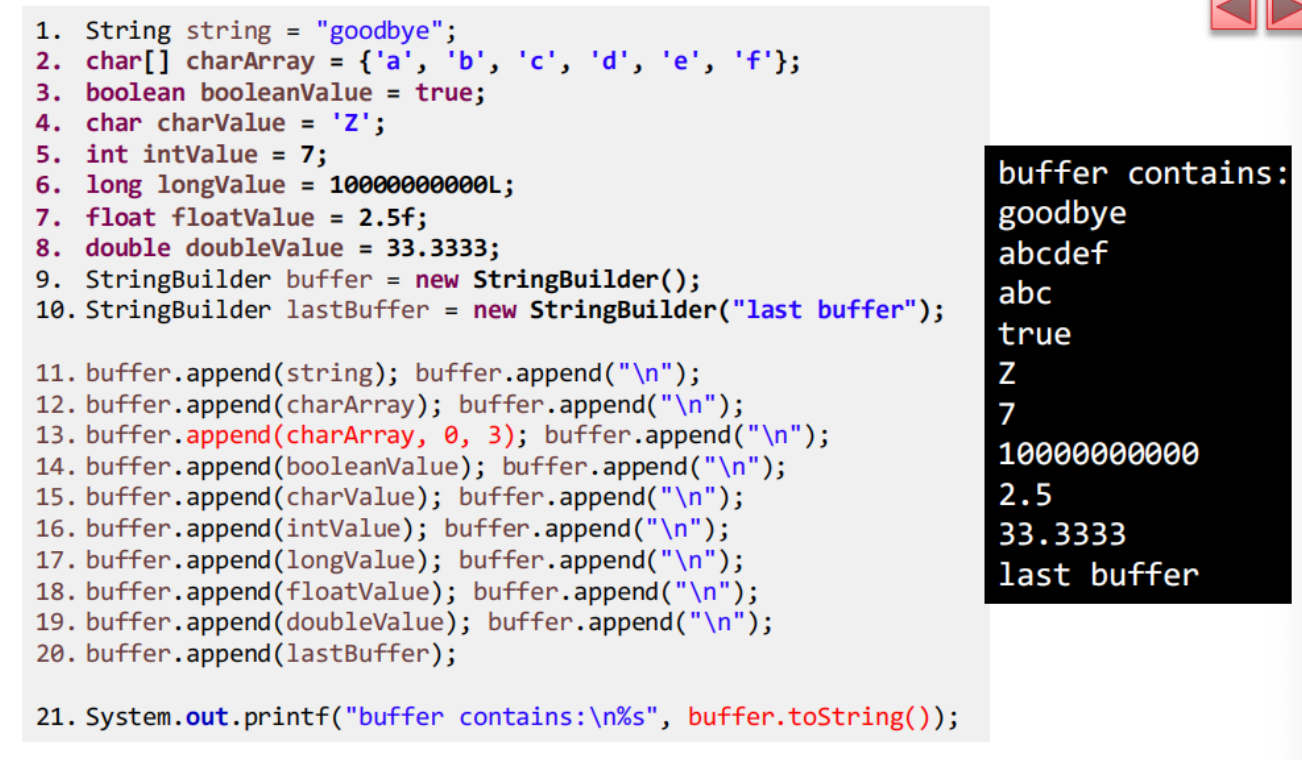
可变字符串 StringBuilder 的操作效率比较高。
包装类(Wrapper Class)可以将八大基础类型作为对象处理:
Boolean, Character, Double, Float, Byte, Short, Integer, Long
也提供了一些静态方法,比如:
Character.isDigit('c'); // false
Integer.parseInt("8"); // 8
Double.parseDouble("3.3"); // 3.3
String.valueOf(123); // "123"
自动装箱(Auto-boxing)和自动拆箱(Auto-unboxing):
int a = 1;
Integer b = a; // auto-boxing
int c = b; // auto-unboxing
类与对象(Class and Object)
类(Class)的属性(Attributes):
- 生命周期(Lifespan):实例从创建到销毁的时间。
- 变量 / 字段(Variables / Fields)
- 方法
包(Package):例如 java.util ,edu.sustech.xiangqi。
可以导入包中的类,例如 import java.util.*。
还可以导入类的静态成员,例如 import static java.lang.Math.*。
但导入了同名的静态成员会有编译错误。
枚举类(Enumerations):
public enum Direction {
	NORTH, SOUTH, EAST, WEST
}
// 用普通类示意枚举常量(不完全等价)
public final class Direction {
	private Direction() {}
	public static final Direction EAST = new Direction();
	public static final Direction WEST = new Direction();
	public static final Direction SOUTH = new Direction();
	public static final Direction NORTH = new Direction();
}
那么 Direction 类型的变量只能赋予这四种,或者 null。
ArrayList<T>:可变长度数组。
// import java.util.ArrayList;
// import java.util.Collections;
ArrayList<Integer> list = new ArrayList<>();
list.add(1);
list.add(2);
System.out.println(list.get(1)); // 2
Collections.sort(list);
Collections.reverse(list);
考虑 static 关键字修饰变量或修饰方法的作用。
继承(Inheritance)
子类(Subclass)继承自超类(Superclass)。
子类可以被当成超类(is-a relationship)。也就是说,父类变量可以放子类对象。
所有类都直接或间接继承自 Object。
一个类只能有一个直接超类。
修饰符:
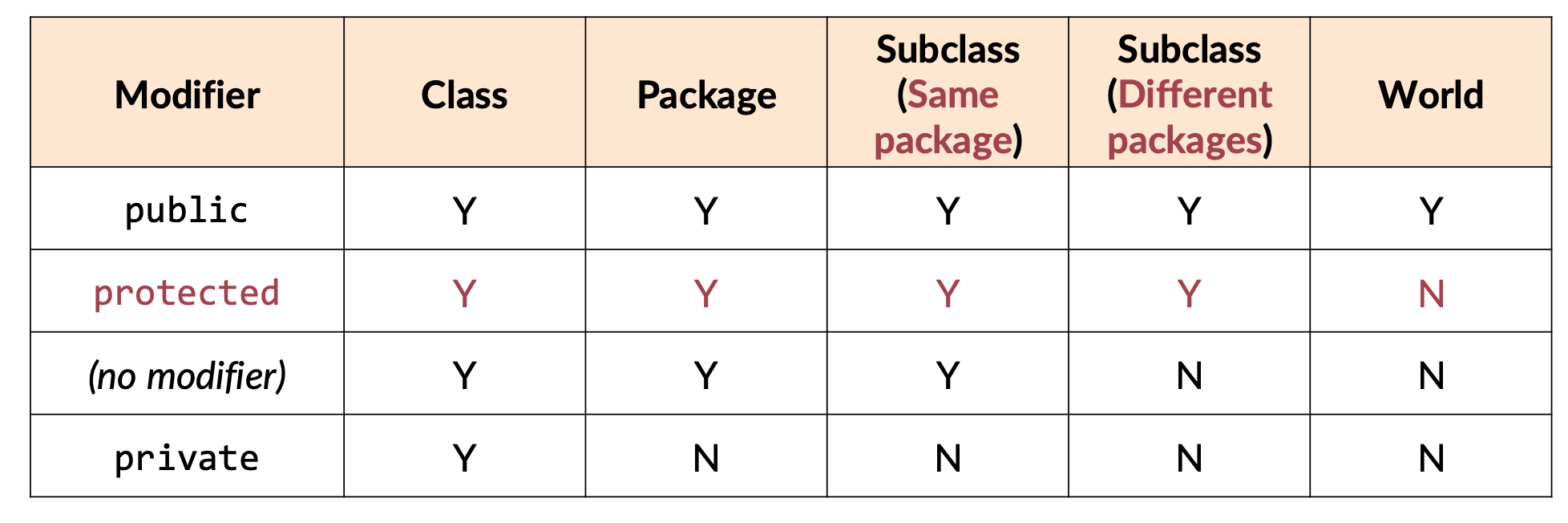
子类不继承超类的 private 成员,但对象仍保留超类的私有状态。
子类可以通过 super 关键字调用(invoke)超类的构造方法。
没有标识符(no modifier)相当于 package-private。
使用 extends 关键字继承。
重写(Overriding)比如
@Override
public String toString() {
	...
}
重写方法的访问级别只能比超类 相同或更高,例如,超类中的 protected 方法可以重写为 public 方法,但不能重写为 private 方法。
重写方法的返回值需要是超类返回类型的 相同或子类型。不过,如果父类方法的返回类型是基本数据类型(如 int, double)或 void,则子类重写方法的返回类型必须完全相同。
不可以重写超类的静态方法和实例变量。但是可以在子类中定义一个与超类实例变量名相同的变量 / 与超类静态方法签名一样的方法,来隐藏超类的这些方法和变量。
class Parent {
    protected int value = 10;
    public static void staticMethod() {
        System.out.println("Parent static");
    }
}

class Child extends Parent {
	private int value = 20; // 隐藏父类的value

	public static void staticMethod() { // 隐藏父类的静态方法
		System.out.println("Child static");
	}

	public void printValues() {
		System.out.println(super.value); // 10(父类的value)
		System.out.println(this.value); // 20(子类的value)
	}
}
Parent.staticMethod(); // 输出 "Parent static"
Child.staticMethod(); // 输出 "Child static"
多态(Polymorphism)
父类变量可以放子类对象。
使用多态时,如果子类和父类有同名的方法,那么调用的是子类还是父类的方法,取决于绑定的模式:
- 动态绑定 (Dynamic Binding):方法调用基于运行时的实际类型,而不是变量的声明类型。
Animal animal; animal = new Fish(); // 隐式转换(Implicit Casting) animal.move(); // 动态绑定,调用的是 Fish 的 move 方法 animal.swim(); // 编译错误,因为 animal 本身没有 swim 这个方法 if (animal instanceof Fish) { Fish fish = (Fish) animal; // 显式转换(Explicit Casting) fish.swim(); // 可以正常运作 } - 静态绑定(Static Binding):
static方法按编译时类型选择,不能动态重写;private方法不被继承,final方法不可重写。可重写的实例方法按运行时对象类型动态绑定。// 考虑上面写的 Parent 和 Child 类,虽然子类隐藏了父类的 staticMethod 方法,但由于静态绑定,还是会调用父类的静态方法 Parent p = new Child(); p.staticMethod(); // 输出 "Parent static"
final 关键字:
- 可以修饰变量,使其赋值后不能重新赋值;引用变量指向的对象仍可能被修改;
- 可以修饰方法,让它不能被子类重写(
private方法不能被重写;static方法可被隐藏,并不隐式声明为final); - 可以修饰类,让它不能被继承(
String / System都是final类)。
abstract 关键字:
- 修饰类,让它变成抽象类。包含抽象方法的类必须声明为抽象类。抽象类也可以不包含抽象方法,可以包含具体方法,也可以包含构造方法(但不能直接调用,只能被子类间接调用)。
- 修饰方法,规定方法必须被(不抽象的)子类实现。显然抽象方法不能是
static或final的。public abstract class Animal { public abstract void move(); }
接口(Interface)
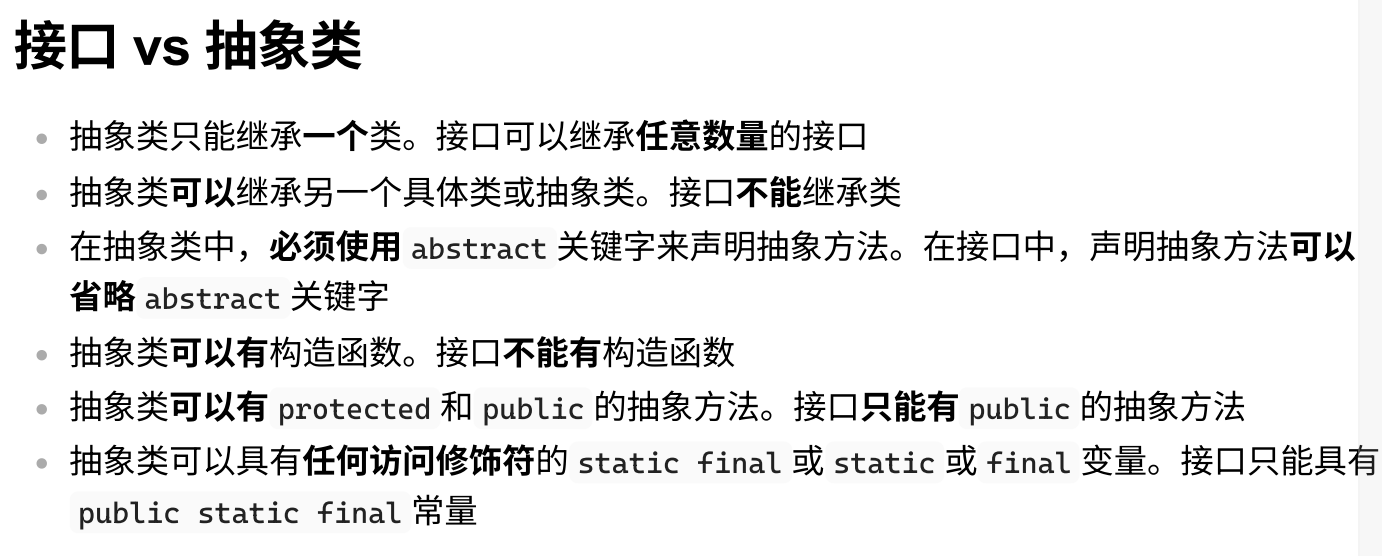
接口与公共的抽象类类似。使用 interface 关键字。
接口不可以包含构造方法。
接口中的常量都隐式被 public static final 修饰。
接口可以包含抽象方法(Abstract) / 默认方法(Default) / 静态方法(Static)。普通无方法体的方法隐式为 public abstract。
不可以直接实例化一个接口,但接口变量可以指向实现了接口的类的实例。
Payable p1 = new Alipay();
一个类只能继承 extends 一个类,但可以实现 ` implements ` 很多个接口。
泛型(Generic Methods)
注意 T 只能是引用类型。
public static <T> void printArray(T[] array) {
	for (T element : array) {
		...
	}
}
public static <T extends Comparable<T>> T maximum(T a, T b, T c) {
	T m = a;
	if (b.compareTo(m) > 0) m = b;
	if (c.compareTo(m) > 0) m = c;
	return m;
}
这里的 extends 声明类型参数的上界:T 必须是 Comparable<T> 的子类型(类通过实现接口满足此条件)。
泛型类(Generic Classes)例如 ArrayList<T>, Stack<T>。
泛型通过类型擦除(Erasure)实现:编译时将类型参数替换为其上界,并插入必要的类型转换。
需要注意泛型的类型安全:
String s = "abc";
Object o = s; // ok
List<String> ls = new ArrayList<String>();
List<Object> lo = ls; // compile error
也就是说,List<String> 并不是 List<Object> 的子类型。
要怎么遍历各种类型的 List 呢,除了使用泛型类型参数(Type Parameter)T,还可以使用通配符(Wildcard)? 。
public void processList(List<?> list) {
	for (Object element : list) {
		...
	}
}
今年不考异常处理。