Logic and Proofs - 逻辑与证明
本页目录
Propositional Logic
命题(Proposition)的定义:
- 陈述性(Declarative)
- 真值(Either true or false)
逻辑连接符(Logic Connectives):
- Negation
\neg - Conjunction/and
\land - Disjunction/or
\lor - Exclusive or
\oplus - Implication
\to - Biconditional
\leftrightarrow
真值表(Truth table):表示不同的命题之间,所有真值(T/F)之间的关系。
- 行数:若涉及
n个命题,则有2^{n}行。
例如异或的真值表:
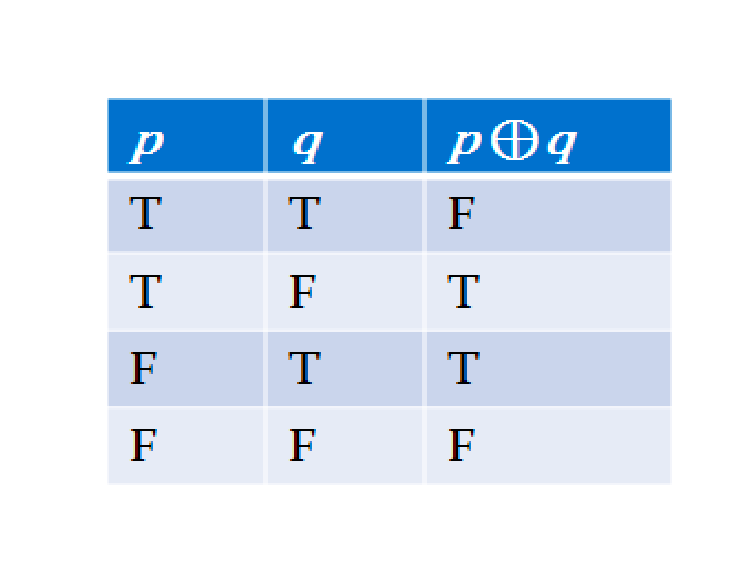
p\oplus q\equiv \neg(p\leftrightarrow q)p\to q \equiv \neg p\lor q(Useful Law)
关于 Implication,有一些对应的概念:
- Converse of
p\to q:q\to p(反/逆命题) - Contrapositive of
p\to q:\neg q\to \neg p(逆否命题) - Inverse of
p\to q:\neg p\to \neg q(否命题)
从 truth table 得到逻辑表达式:把那些 True 的行用 disjunction 连接,例如异或可以写成 (p\land \neg q)\lor(\neg p\land q)。
一个 bit 就可以表示 0 和 1。
计算机中布尔变量(Boolean Variable)表示 0 和 1。
Bit string 就是一些 bit 组成的序列。
按位操作(bitwise operation):把 T 和 F 替换为 1 和 0 进行运算。
George Boole:布尔代数(Boolean algebra)的发明者。
Tautology:永真式。(逻辑等价于 T)
Contradiction:永假式。(逻辑等价于 F)
Contingency:可真可假。
逻辑等价(Logical Equivalent):
- 一种定义:
p与q具有相同的真值表。 - 另一种定义:
p\leftrightarrow q是永真式。 - 记作
p\equiv q或p \iff q。
De Morgan’s Law:
\neg(p\lor q)\equiv \neg p\land \neg q\neg(p\land q)\equiv \neg p\lor \neg q
Identity Law:
p\land T\equiv pp\lor F\equiv p
Domination Law:
p\lor T\equiv Tp\land F\equiv F
Idempotent Law:
p\lor p\equiv pp\land p\equiv p
Double negation Laws:
\neg(\neg p)\equiv p
Commutative Laws:
p\lor q\equiv q\lor pp\land q\equiv q\land p
Associative Laws:
(p\lor q)\lor r\equiv p\lor(q\lor r)(p\land q)\land r\equiv p\land(q\land r)
Distributive Laws:
p\lor(q\land r)\equiv(p\lor q)\land(p\lor r)p\land(q\lor r)\equiv(p\land q)\lor(p\land r)
Absorption Laws
p\lor(p\land q)\equiv pp\land(p\lor q)\equiv p
Negation Laws
p\lor \neg p\equiv Tp\land \neg p\equiv F
证明逻辑等价的方法:
- Truth table
- Logical Equivalence inference
- By discussion
Predicate Logic / First Order Logic
有量词的逻辑。
- Existential Quantifier:
\exists - Universal Quantifier:
\forall
谓词逻辑包含
- Constant
- Variable
- Predicate:
P(x)给每个x赋一个 T / F 值。
Predicate P(x_{1},\dots,x_{n}) 只能称为Statement;只有当每个 x_{i} 换成具体的值,或用量词约束全部自由变量,它才成为一个 proposition(具有真值)。
- Universe/Domain:所有可能取值
(x_{1},x_{2}\dots x_{n})的集合。 - Truth set:让
P(x_{1},\dots ,x_{n})成立的取值(x_{1},x_{2}\dots x_{n})的集合。
\forall 和 \exists 的优先级比其他逻辑运算符更高。
通常 \forall, \to 搭配,\exists, \land 搭配。
\neg \exists x P(x)\equiv \forall x\neg P(x)(De Morgan Law) 否定之后改变量词类型,把否定放到谓词上。这对嵌套也成立:\neg(\forall x\exists yP(x,y))\equiv \exists x\forall y\neg P(x,y)。\neg \forall x(P(x)\to Q(x))\equiv \exists x(P(x)\land \neg Q(x))
嵌套的量词若种类不同不可交换。
翻译:There is EXACTLY one person whom everybody loves.
\exists y(\forall xL(x,y) \land \forall z(\forall xL(x,z)\to z=y))
Inference
对于命题逻辑有如下的 Inference Rules:
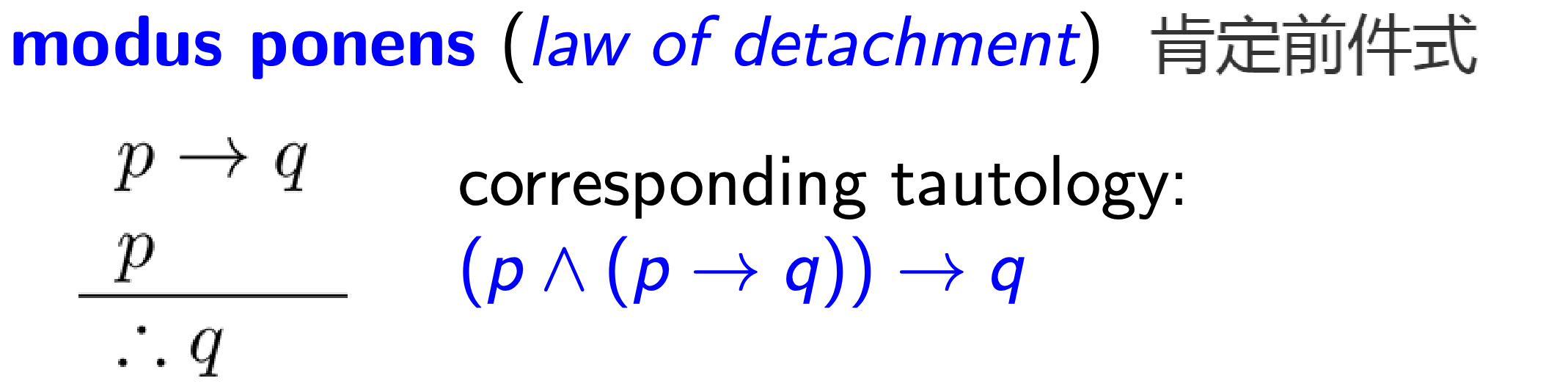
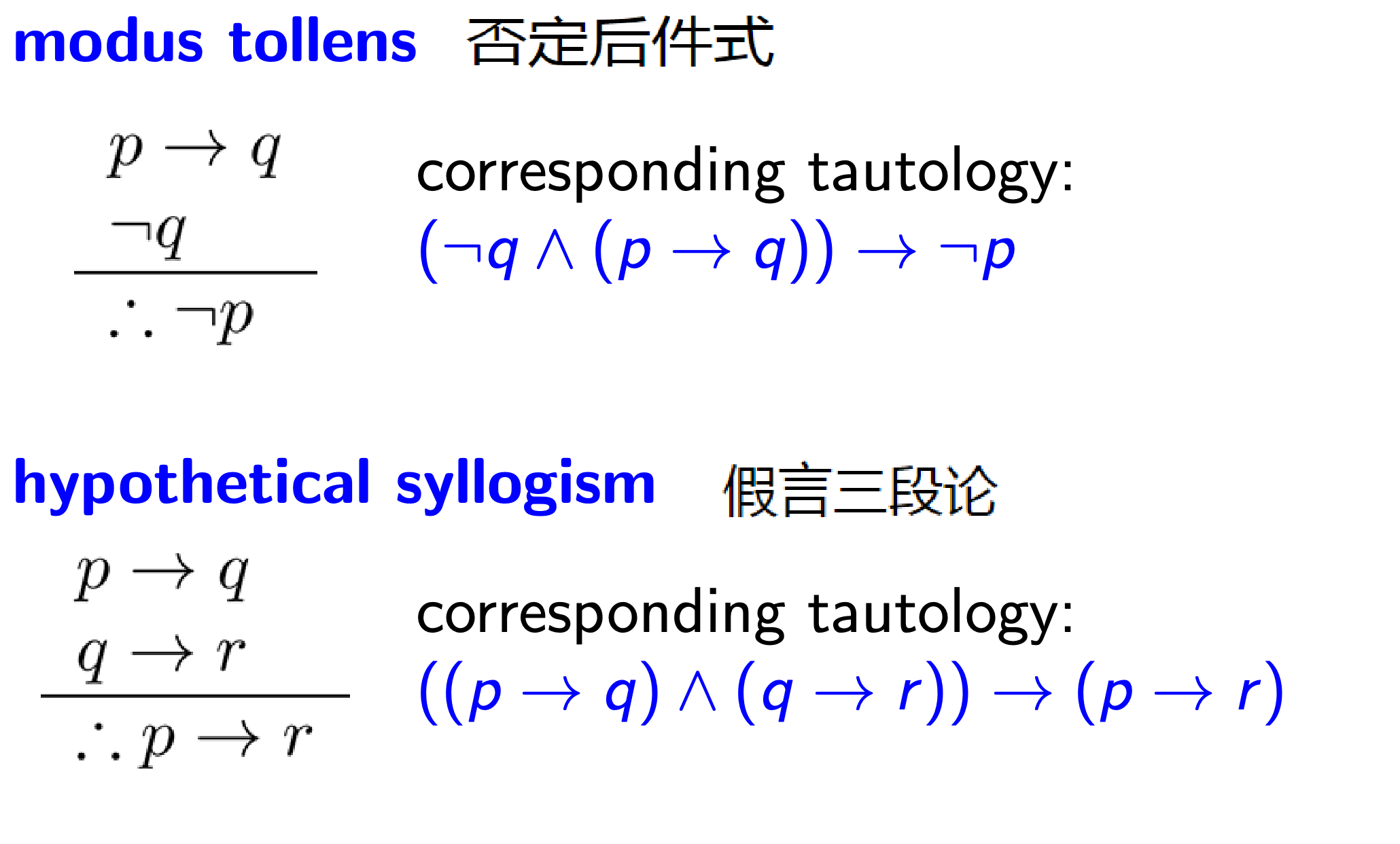
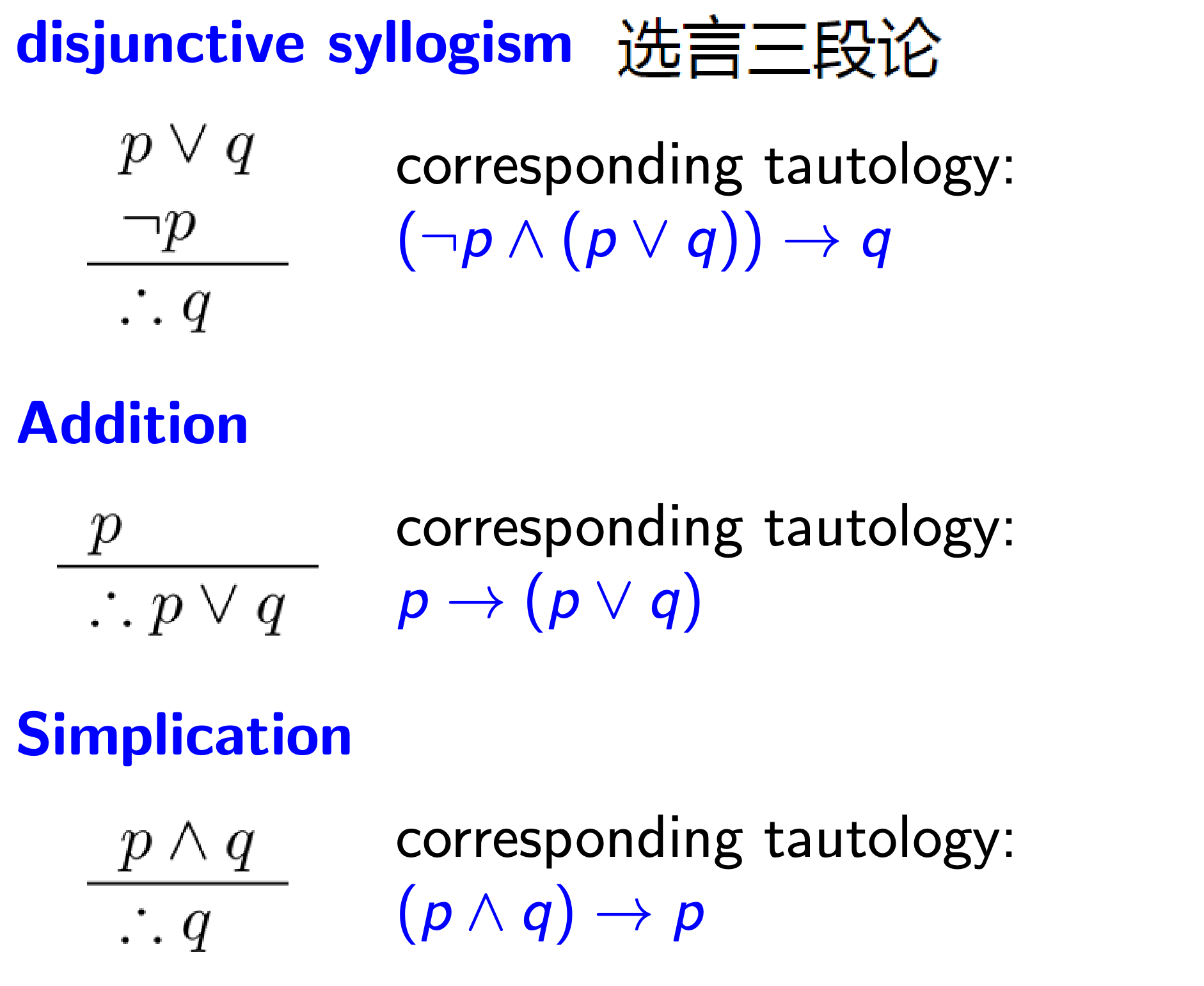
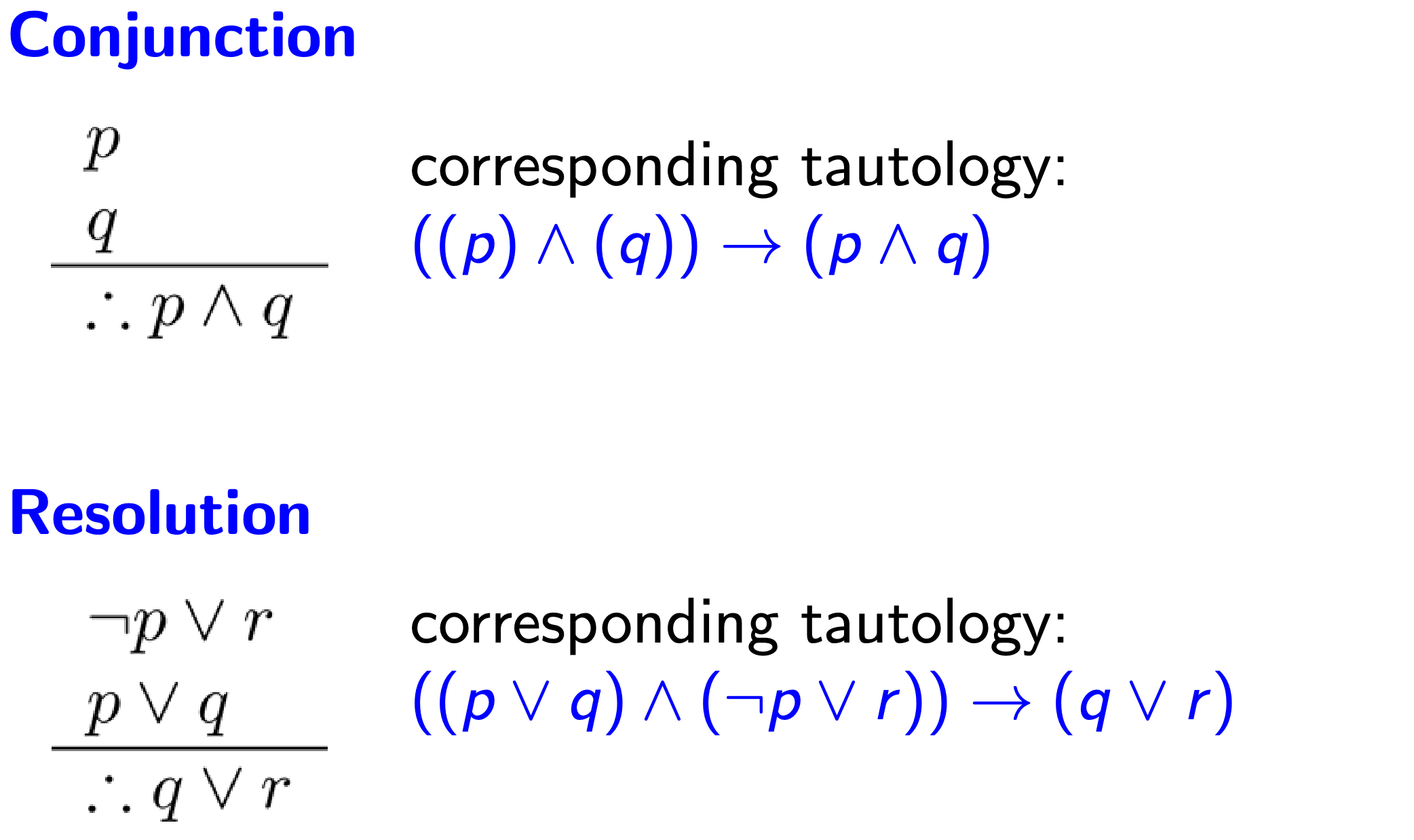
对于一阶逻辑:
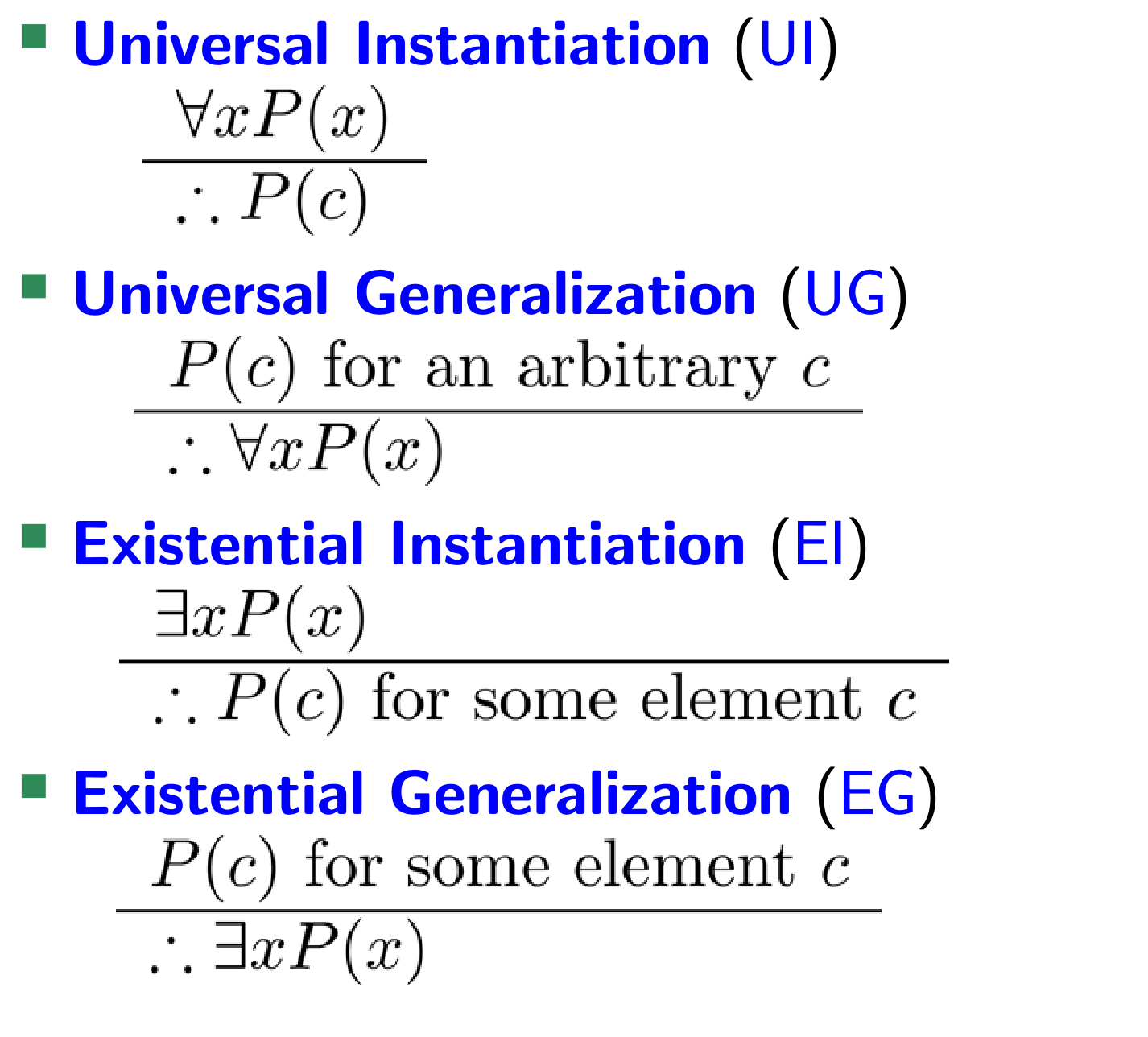
数学证明(Mathematical Proof)
Axiom(公理): 在一个理论中选定、不经证明而作为推理起点的命题。
Theorem(定理): 可以证明的命题。
Lemma(引理): 可以证明的命题,用于证明其他命题。
Corollary(推论): 从定理可以推出来的结论。
Formal Proof: 每一步都遵循逻辑,从前提/公理/引理/定理中获得。
Informal Proof: 更常用,使用自然语言。
证明定理(形如 p\to q)的基本方法(可以通过 p\to q 的真值表理解):
- Direct proof
- Proof by contrapositive (逆否命题)
- Proof by contradiction(说明
p\land \neg q不可能发生以说明p\to q) - Proof by cases (
(p_{1}\lor\dots \lor p_{n})\to q \equiv(p_{1}\to q)\land(p_{2}\to q)\land\dots \land(p_{n}\to q)) - Proof of equivalence (
p\leftrightarrow q\equiv(p\to q)\land(q\to p))
Vacuous Proof:证明p永远是假的,那么p\to q就是真的。
Trivial Proof:证明q永远是真的,那么p\to q就是真的。
证明含量词的命题 - Proof by cases
- Counterexample
- Constructive proof
- Non constructive - proof by contradiction