0 - Search
本页目录
Search Problem
Concepts: Agent(智能体), State(状态) (Initial State(初始状态)), Actions(动作), Transition Model(转移模型), State Space(状态空间), Goal Test(目标测试), Path Cost(路径代价).
Transition Model(转移模型): A function
\text{Result(s, a)}returns the state resulting from performing action\text{a}in state\mathrm{s}.
Solving Search Problem
Concepts: Solution(解) (Optimal Solution(最优解)), Node(节点), Frontier(前沿/边界)
Frontier(前沿/边界): the mechanism that “manages” the nodes.
Search Processes: Repeat
- If the frontier is empty: Stop. There is no solution to the problem.
- Remove a node from the frontier. This is the node that will be considered.
- If the node contains the goal state: Return the solution. Stop.
Else,- Add the current state to the explored set. Expand the node and add successor states that are neither explored nor already in the frontier.
- The explored set(已探索集合)stores states.
Depth-First Search, DFS(深度优先搜索)
DFS uses a stack(栈) as the frontier.
Breadth-First Search, BFS(广度优先搜索)
BFS uses a queue(队列) as the frontier.
Guaranteed to find the shortest path in number of steps; optimal in path cost when every step has the same positive cost(每步代价相同时保证最优).
Greedy Best-First Search, GBFS(贪心最佳优先搜索)
Concepts: Uninformed / Informed Search Algorithm(无信息/有信息〔启发式〕搜索算法).
Informed Search Algorithm(有信息/启发式搜索算法): Consider additional knowledge to improve its performance.
GBFS expands node with lowest value of h(n).
h(n)=\text{estimate cost to goal}
Not guaranteed to find the optimal solution(不保证找到最优解).
A* Search(A* 搜索)
A* search expands node with lowest value of h(n)+g(n).
g(n)=\text{cost to reach node}
h(n)is admissive(可采纳) if0\leq h(n)\leq h^*(n)(h^*(n)is the real cost to goal).h(n)is consistent(一致的) ifh(n)\leq h(n')+\text{cost}(n\to n').
A* search is optimal(最优) if
h(n)is admissive and consistent.
Minimax & Alpha-Beta Pruning(极大极小与 α-β 剪枝)
Concepts: Adversarial Search(对抗搜索)
Game(博弈)
- Initial State
S_{0}(初始状态) \text{Player}(s)(玩家),\text{Actions}(s)(动作),\text{Result}(s, a)(结果/转移),\text{Terminal}(s)(终止),\text{Utility}(s)(效用)
Minimax(极大极小)
Given a state s
- The maximizing player(最大化玩家) picks action
ain\text{Actions}(s)that produces the highest value of\text{Min-Value}(\text{Result}(s, a)). - The minimizing player(最小化玩家) picks action a in
\text{Actions}(s)that produces the lowest value of\text{Max-Value}(\text{Result}(s, a)).
Alpha-Beta Pruning(α-β 剪枝)
Keep tracking:
\alpha: The lower bound(下界) of the score that the maximizing player can reach.\beta: The upper bound(上界) of the score that the minimizing player can reach.
If\alpha \geq \betaholds for a node, there is no need to expand the node any more.
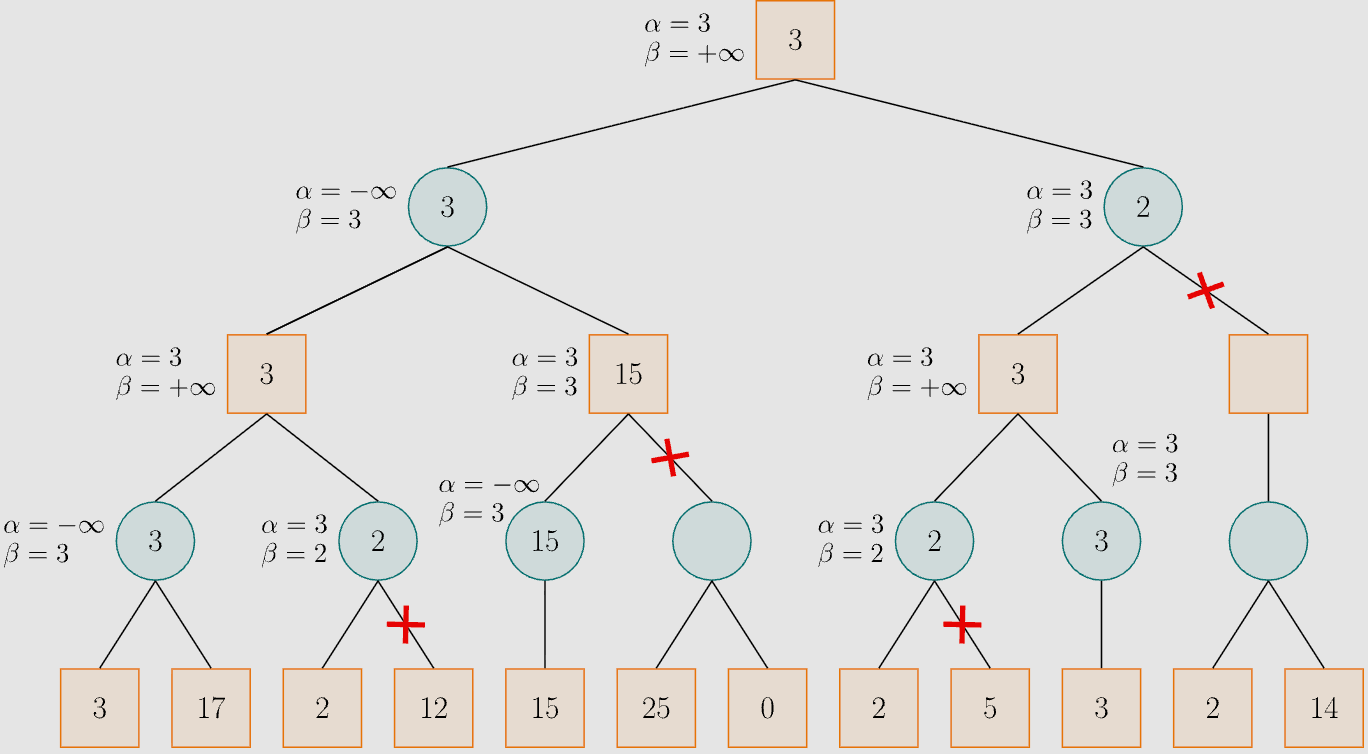
\begin{algorithm}
  \caption{Alpha-Beta Pruning}
  \begin{algorithmic}
    \Require{A node \texttt{u}, alpha bound \texttt{alph}, beta bound \texttt{beta}, a boolean \texttt{is\_max}, an evaluation function \texttt{Evaluate}}
    \Function{AlphaBeta}{\texttt{u}, \texttt{alph}, \texttt{beta}, \texttt{is\_max}}
      \If{\texttt{u} has no children}
        \State \Return \texttt{Evaluate(u)}
      \EndIf
      \If{\texttt{is\_max} = true}
        \ForAll{\texttt{child} of \texttt{u}}
          \State \texttt{alph} $\gets$ $\max(\texttt{alph}, \texttt{AlphaBeta(child, alph, beta, false)})$
          \If{\texttt{alph} $\ge$ \texttt{beta}}
            \Break
          \EndIf
        \EndFor
        \State \Return \texttt{alph}
      \Else
        \ForAll{\texttt{child} of \texttt{u}}
          \State \texttt{beta} $\gets$ $\min(\texttt{beta}, \texttt{AlphaBeta(child, alph, beta, true)})$
          \If{\texttt{alph} $\ge$ \texttt{beta}}
            \Break
          \EndIf
        \EndFor
        \State \Return \texttt{beta}
      \EndIf
    \EndFunction
  \end{algorithmic}
\end{algorithm}