大化 Midterm Review
本页目录
Chapter 1
Classification of Matter
- Heterogeneous
- Homogeneous
- Mixture(Solution)
- Pure Substance
- Element
- Compound
Properties
- Intensive
- Extensive
Measurements
- Accuracy
- Precision
Significant Number
+/-: Lowest significant decimal places\times / \div: Lowest significant numbers
Chapter 2
Atom
- Proton
- Electron
- Neutron
Isotope and Atomic Weight
Formula
- Empirical / molecular
Ion
- Cation
- Just use the element name
- Label the oxidation state (e.g., copper (II)) if necessary
- Anion
- -ide / -ate / -ite / per- / hypo- / hydro- … , for different type of anions
Molecular Compounds
- Prefix:
- Mono-
- Di-
- Tri-
- Tetra-
- Penta-
- Hexa-
- Hepta-
- Octa-
- Nona-
- Deca-
Chapter 3
Formula weight and molecular weight
%Element=(number of atoms) \times (atomic weight) / (formula weight) \times 100%
Limiting Reactants / Excess Reactants
Theoretical Yield / Actual Yields
- %Yield
Chapter 4
Solutions
- Solutes
- Solvent
- Aqueous Solution
- Dissociation
- Electrolyte
- Nonelectrolyte
- Dissociation
Solubility of Ionic Compounds
- Common Soluble Compounds:
\ce{NO_{3}- / CH_{3}COO-}: No exception\ce{Cl- / Br- / I- :Ag+, Hg_{2}^2+, Pb^2+}Precipitation\ce{SO_{4}^2- : Sr^2+, Ba^2+, Hg_{2}^2+, Pb^2+}Precipitation
- Common Insoluble Compounds
\ce{S^2- / OH- : NH_{4}+, \text{alkali metal cations}, Ca^2+, Sr^2+, Ba^2+}Soluble\ce{CO_{3}^2- / PO_{4}^3- : NH_{4}+, \text{alkali metal cations}}Soluble
Reactions Types
- Precipitation Reaction
- Exchange Reaction
- Displacement Reaction
- Neutralization Reaction
- Oxidation / Reduction Reaction
- Combination / decomposition
- Combustion
Acid / Base
- Arrhenius (increase
\ce{[H+] / [OH-]}) / Brønsted (Donate / Accept Protons) - Strong / Weak
- Strong Acids:
\ce{HCl, HBr, HI, HClO_{3}, HClO_{4}, HNO_{3}, H_{2}SO_{4}} - Strong Bases:
\ce{LiOH, NaOH, KOH, RbOH, CsOH, Ca(OH)2, Sr(OH)2, Ba(OH)2}
- Strong Acids:
Oxidation Numbers
Molarity
Dilution
Titration
Chapter 6
Wavelength of different radiation(increasing order)
- X-ray
- Ultraviolet
- Infrared
- Microwave
- Television
- Radio
Isoelectronic
Photoelectric Effect E=h\nu = E_{k}+I
Continuous / Line Spectra
- Element - Line spectrum
Wave Nature of Matter \lambda = \frac{h}{mv}
Heisenberg’s uncertainty principle (\Delta x)(\Delta p)\geq \frac{h}{4\pi}
\lvert \psi\rvert ^2=\psi^*\psi gives electron probability density
Quantum Numbers
- Principal quantum number - shells/orbitals -
n - Angular quantum number - subshells -
l(0\leq l\leq n-1) - Magnetic quantum number -
m_{l} (-l\leq m_{l} \leq l) - Spin quantum number -
m_{s}(\frac{1}{2} / -\frac{1}{2})
Electron Configuration / Orbital Diagram
- Pauli Exclusion Principle
- Hund’s Rule
- Aufbau principle
- Condensed Electron Configuration
Exception\ce{[Ar] 3d^5 4s^1, [Ar] 3d^10 4s^1}
Chapter 7
Effective Nuclear Charge Z_{\mathrm{eff}}=Z-S
- Calculation is not required , as Chapter 8 & 9 are harder
Size of atom
- Anion > Parent Atom > Cation
- Isoelectronic Series <- Judge from Nuclear Charge
Ionization Energy
I_{n}Energy required to remove the nth electron- Judge group of a element (e.g. Al has a sharp increase from
I_{3}toI_{4}) - Always endothermic
Electron Affinity
- Energy change with addition of electron
- Can be endothermic or exothermic
Metals, nonmetals and metalloids
- Metals: lustrous, malleable; oxides tend to be basic
- Nonmentals: dull; gain electron
- Metals and nonmentals tend to form ionic compound
Groups
- Alkali metals, Alkaline earth metals, Boron group, Carbon group, Nitrogen group, Chalcogens, Halogens, noble gases
Chapter 8
Chemical bonds
- Ionic bonds
- Covalent bonds
- Metallic bonds
Lewis Symbols
- Octet rule
Lattice Energy
\ce{NaCl(s)-> Na+(g) + Cl-(g)}, E_{el}=\frac{\kappa Q_{1}Q_{2}}{d}- The energy required to break the ionic bonds
\Delta H_{lattice}=\Delta H\degree_{f}[\ce{Na(g)}] + \Delta H\degree_{f}[\ce{Cl(g)}] + I_{1}(\ce{Na})+E(\ce{Cl}) - \Delta H\degree_{f}[\ce{NaCl(s)}]\Delta H\degree_{f}[\ce{X}]: The energy change when forming X- The addition part:
\ce{Na(s) + \frac{1}{2}Cl_{2}(g) -> Na+(g) + Cl-(g)} - The subtraction part:
\ce{Na(s) + \frac{1}{2}Cl_{2}(g) -> NaCl(s)}
Bond Polarity
- Dipoles
\mu=Qr- Units:
\text{Debyes (D)}(carefully convert to\mathrm{C} \cdot \mathrm{m})
- Units:
Lewis Structure
- Assign the electrons with the Octet Rule (especially for period 2); H and He follow the duet rule
- Exceptions
- odd number of electrons (
\ce{NO}) - less than an octet of valence electron(
\ce{BF3}) - more than eight valence electrons (an expanded octet) (
\ce{PF5})
- odd number of electrons (
- Exceptions
- Formal Charge = Valence electrons - 1/2(bonding electrons) - all nonbonding electrons
- Minimized Formal Charge gives the most stable structure
Resonance Structures
- Delocalized electrons
Bond Enthalpy
\Delta H_{\mathrm{rxn}}\approx\sum\Delta H(\text{bonds broken})-\sum\Delta H(\text{bonds formed})(这里两项均取正的平均键焓:断键吸热,成键放热)
Chapter 9
VSEPR Theory
| Electron Domains | Electron-Domain Geometry | Predicted Bond Angle |
|---|---|---|
| 2 | Linear | 180° |
| 3 | Trigonal planar | 120° |
| 4 | Tetrahedral | 109.5° |
| 5 | Trigonal bipyramidal | 120°, 90° |
| 6 | Octahedral | 90° |
| Number of Electron Domains | Nonbonding Domains | Molecular Geometry | Example |
|---|---|---|---|
| 2 | 0 | Linear | \ce{CO_{2}} |
| 3 | 0 | Trigonal planar | \ce{BF_{3}} |
| 3 | 1 | Bent | \ce{NO_{2}-} |
| 4 | 0 | Tetrahedral | \ce{CH_{4}} |
| 4 | 1 | Trigonal pyramidal | \ce{NH_{3}} |
| 4 | 2 | Bent | \ce{H_{2}O} |
| 5 | 0 | Trigonal bipyramidal | \ce{PCl_{5}} |
| 5 | 1 | Seesaw | \ce{SF_{4}} |
| 5 | 2 | T-shaped | \ce{ClF_{3}} |
| 5 | 3 | Linear | \ce{XeF_{2}} |
| 6 | 0 | Octahedral | \ce{SF_{6}} |
| 6 | 1 | Square pyramidal | \ce{BrF_{5}} |
| 6 | 2 | Square planar | \ce{XeF_{4}} |
Valence Bond Theory and Hybrid Orbitals
\sigmabond: head-to-head\pibond: side-to-side (weaker), not hybridized orbitals- Hypervalent: more than an octet of electrons
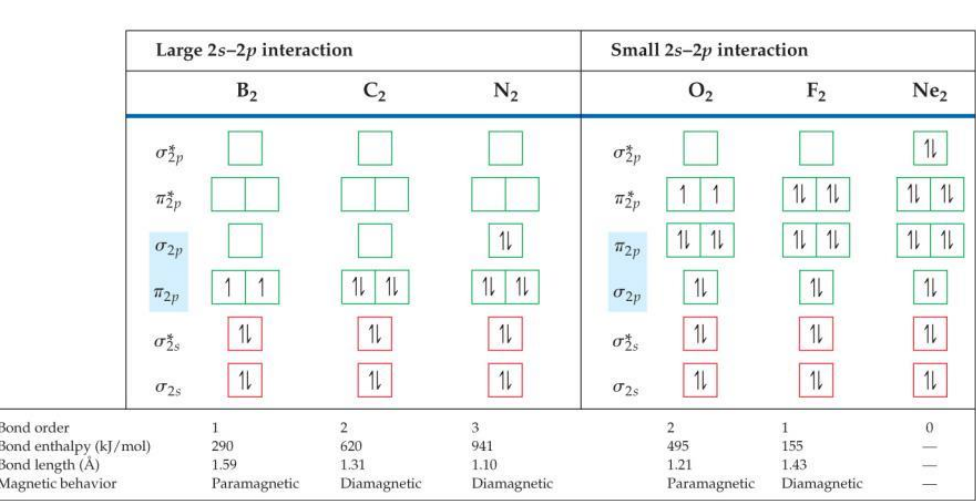
Molecular Orbital Theory
- Bonding orbitals and Antibonding orbitals
- Bond Order = 1/2 (Bonding electrons - Antibonding electrons)
- HOMO : highest occupied molecular orbital
- LUMO : lowest unoccupied molecular orbital
- Paramagnetism: have unpaired electrons
- Diamagnetism: no unpaired electrons